INVESTIGATION – Diverting controlled substances

You are contacted to investigate the suspicion that a nurse is diverting controlled substances. The suspicious behavior was reported by two coworkers who consistently work with “Nurse A”. Their suspicions are based on the fact that “Nurse A” seems to be accessing the ADC an excessive amount and removing controlled substances compared to the rest of the nurses. “Nurse A” also seldom asks for a witness to waste controlled substances (per protocol, all controlled substance waste must be witnessed in the ADC with another nurse, which generates an electronic record of the waste transaction). You have access to run reports at the ADC level and on the EMR. Why is the ADC and the EMR interface so important in this situation to assist with investigating the waste concern brought up by “Nurse A’s” coworkers? Think about usage patterns of controlled substances on “Nurse A’s” patient care unit. What information would you want in a report to compare “Nurse A” to all other nursing personnel that work on the patient care unit? Another piece of the investigation involves ensuring the controlled substance counts and handling are correct from the point at which the nurse initially access’ the controlled substances in the ADC. How will closed loop automation assist you in tracking the chain of custody of controlled substances from the point it leaves the pharmacy to the point it reaches the patient care unit? Describe any additional information that you think would be helpful to investigate a suspected diversion issue.

Click here to request for this assignment help

The post INVESTIGATION – Diverting controlled substances appeared first on This Assignment Help.

 
Looking for a Similar Assignment? Order now and Get 10% Discount! Use Coupon Code "Newclient"

Report – Creating Change for Sustainability

Read paper requirement and all files before you start.2.Please only use academic sources. 3.No direct quotation. Similarity should under 10%including reference list4.Please follow the paper structure/word limit.The final version should include 500 words evaluation report 50 words daily recording notes*10days.5.Please check your paper with the Rubric before you delivery it6.Please use academic vocabulary, no grammar errors7.Please give me a draft of whatever you have at least 3 days before the final deadline.

Click here to request for this assignment help

The post Report – Creating Change for Sustainability appeared first on This Assignment Help.

 
Looking for a Similar Assignment? Order now and Get 10% Discount! Use Coupon Code "Newclient"
intermolecular forces

THIS POST WAS COPIED FROM Academicheroes.com Best Essays.

FOR HELP, VISIT THEIR WEB PAGE AT : https://www.Academicheroes.com/

GET QUALITY ESSAY HELP BY VISITING Best Essays – Academicheroes.com HERE :

https://www.Academicheroes.com/

Ionic Substances Ions form when the charge imbalance between bonded atoms is so large that one or more electrons are basically, transferred from one atom to another. When this happens ions are formed (both positively charge and negatively charged ions). If you put a bunch of positively charged and negatively charged ions in one place […]

THIS POST WAS COPIED FROM Academicheroes.com Best Essays.

GET QUALITY ESSAY HELP BY VISITING Academicheroes.com HERE :

https://www.Academicheroes.com/

 
Looking for a Similar Assignment? Order now and Get 10% Discount! Use Coupon Code "Newclient"

Some medications are formulated such that there is a slow release of the active ingredients. Such formulations known as “extended release.” Azithromycin ER is a single-dose, extended release formulation. The recommended dosage for a child 6 months and older who is brought to the Emergency Room with community acquired pneumonia is 60 mg/kg administered orally. Azithromycin (immediate release) has much faster onset of action and acts almost immediately when administered intravenously

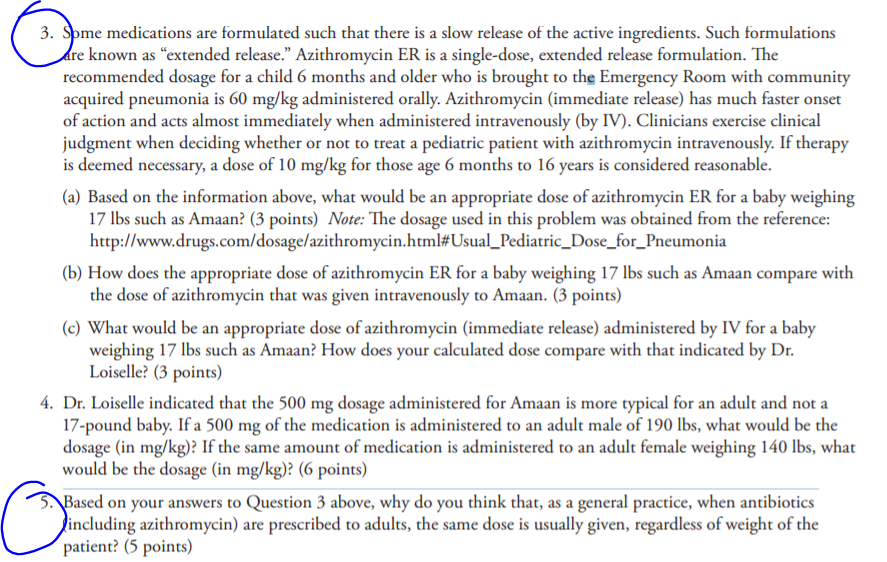
3. Spme medications are formulated such that there is a slow release of the active ingredients. Such formulations known as extended release. Azithromycin ER is a single-dose, extended release formulation. The recommended dosage for a child 6 months and older who is brought to the Emergency Room with community acquired pneumonia is 60 mg/kg administered orally. Azithromycin (immediate release) has much faster onset of action and acts almost immediately when administered intravenously (by IV). Clinicians exercise clinical judgment when deciding whether or not to treat a pediatric patient with azithromycin intravenously. If therapy is deemed necessary, a dose of 10 mg/kg for those age 6 months to 16 years is considered reasonable (a) Based on the information above, what would be an appropriate dose of azithromycin ER for a baby weighing 17 lbs such as Amaan? (3 points) Note: The dosage used in this problem was obtained from the reference: http://www.drugs.com/dosage azi thromycin.html# Usual Pediatric Dose for Pneumonia (b) How does the appropriate dose of azithromycin ER for a baby weighing 17 lbs such as Amaan compare with the dose of azithromycin that was given intravenously to Amaan. (3 points) (c) What would be an appropriate dose of azithromycin (immediate release) administered by IV for a baby weighing 17 lbs such as Amaan? How does your calculated dose compare with that indicated by Dr Loiselle? (3 points) 4. Dr. Loiselle indicated that the 500 mg dosage administered for Amaan is more typical for an adult and not a 17-pound baby. If a 500 mg of the medication is administered to an adult male of 190 lbs, what would be the dosage (in mg/kg)? If the same amount of medication is administered to an adult female weighing 140 lbs, what would be the dosage (in mg/kg)? (6 points) ased on your answers to Question 3 above, why do you think that, as a general practice, when antibiotics including azithromycin) are prescribed to adults, the same dose is usually given, regardless of weight of the patient? (5 points)


Some medications are formulated such that there is a slow release of the active ingredients. Such formulations known as “extended release.” Azithromycin ER is a single-dose, extended release formulation. The recommended dosage for a child 6 months and older who is brought to the Emergency Room with community acquired pneumonia is 60 mg/kg administered orally. Azithromycin (immediate release) has much faster onset of action and acts almost immediately when administered intravenously (by IV). Clinicians exercise clinical judgment when deciding whether or not to treat a pediatric patient with azithromycin intravenously. If therapy is deemed necessary, a dose of 10 mg/kg for those age 6 months to 16 years is considered reasonable. (a) Based on the information above, what would be an appropriate dose of azithromycin ER for a baby weighing 17 lbs such as Amaan? (b) How does the appropriate dose of azithromycin ER for a baby weighing 17 lbs such as Amaan compare with the dose of azithromycin that was given intravenously to Amaan. (c) What would be an appropriate dose of azithromycin (immediate release) administered by IV for a baby weighing 17 lbs such as Amaan? How does your calculated dose compare with that indicated by Dr Loiselle? Dr. Loiselle indicated that the 500 mg dosage administered for Amaan is more typical for an adult and not a 17-pound baby. If a 500 mg of the medication is administered to an adult male of 190 lbs, what would be the dosage (in mg/kg)? If the same amount of medication is administered to an adult female weighing 140 lbs, what would be the dosage (in mg/kg)? Based on your answers to Question 3 above, why do you think that, as a general practice, when antibiotics (including azithromycin) are prescribed to adults, the same dose is usually given, regardless of weight of the patient?

The post Some medications are formulated such that there is a slow release of the active ingredients. Such formulations known as “extended release.” Azithromycin ER is a single-dose, extended release formulation. The recommended dosage for a child 6 months and older who is brought to the Emergency Room with community acquired pneumonia is 60 mg/kg administered orally. Azithromycin (immediate release) has much faster onset of action and acts almost immediately when administered intravenously appeared first on Academicheroes.com.

 
Looking for a Similar Assignment? Order now and Get 10% Discount! Use Coupon Code "Newclient"