CASE STUDY – PURCHASING & PROCUREMENT MANAGEMENT SBS MBA SPECIALIZATION: THE IKEA GROUP ASSIGNMENT I

The IKEA Group ASSIGNMENT I On  PURCHASING & PROCUREMENT MANAGEMENT SBS MBA SPECIALIZATION

  
Total Marks: _______ /40
The IKEA Group, a Swedish company founded in 1943 with its headquarters in Denmark, is a multinational operator of a chain of stores for home furnishing and house-wares. It is the world’s largest furniture retailer, specializing in stylish but inexpensive Scandinavian designed furniture.  The IKEA group owns over 2700 stores in 35 countries, with sales in 2007, £13,414.0 (million), and sales growth of 21.7%.  It has 118,000 employees.  It has been hugely successful since its origin in 1943 as a mail order catalogue featuring locally produced furniture.
Some of the key reasons for IKEA’s success include:
The IKEA brand is associated with simple, low cost, stylish products.  The concept was furnishing products and house-wares that had wide appeal to a variety of markets and segments, both consumer and the business market exclusively.  Both markets were looking for well styled, high quality furniture that reasonably priced and readily available.
Initially, IKEA did not customize its products to local markets, but kept to standardized products and operations worldwide.  This standardized strategy of internationalizing minimized costs.
IKEA developed a model for the business, where it was able to keep costs low.   From the customer point of view, they were able to buy low cost furniture, however they had to assemble and collect the flat-packed furniture from stores.  IKEA to was able to reduce costs, as this costly part of the value chain was carried out by the customer.
IKEA had excellent international procurement. Thirty buying offices were created to source from over 1,400 suppliers worldwide, IKEA negotiated prices that were between 20-40% lower than competitors for comparable goods. IKEA was successful at i) identifying worldwide suppliers and ii) managing quality and iii) prices with suppliers, to keep margins low.
It had excellent supply chain management and utilized the latest IT infrastructure.  Due to the sheer number of orders and components required by the company – IKEA developed an efficient system for ordering from suppliers, integrating them into products and delivering them to stores.  This was achieved by a world network of 14 warehouses.  Inventory was stored – and the IT system managed supply and demand to stores, keeping inventory costs low.
Anticipating the needs and wants of customers. IKEA was successful in product design and ensuring ranges were modern and of good quality.
 
 
Challenges and outlook for IKEA:
Its expansion into the US market. It adopted an ethnocentric strategy for going international – where it had standardized products and standardized operations. This helped to keep costs low, but ignored the different tastes and preferences of the US market and the way they purchased furniture. IKEA had to change the model of operating, giving greater ownership to its US subsidiary, to become polycentric – stores in the US had the ability to adapt furniture and customize to suit the local market. Costs increased as a result, but this localization approach was necessary for sales.
IKEA has looked towards emerging markets e.g. China for growth. Further adaptation to products has been necessary – including pricing strategy. Income levels of consumers is lower and stores needed to be located within the cities as car ownership is lower. IKEA has experienced greater competition from national brands.
 
ANSWER ALL THE QUESTIONS( 2 x 20= 40marks)

  1. Assume that you are a competitor of IKEA, discuss what all procurement strategies you adopt to beat the competition.
  2. Discuss how the new procurement and purchase strategies will help you in business


Looking for a Similar Assignment? Order now and Get 10% Discount! Use Coupon Code "Newclient"

CASE STUDY ON DELL GROUP ASSIGNMENT II – PURCHASING & PROCUREMENT MANAGEMENT

Case Study on Dell Group ASSIGNMENT II – Get Answers

PURCHASING & PROCUREMENT MANAGEMENT-  
SBS MBA SPECIALIZATION
ASSIGNMENT II
 
Total Marks: _______ /60
 
Dell relies on a unique supply chain slrategy that gathers large volumes of customer information through its direct sales model and share it with internal procurement and sales department as well as external suppliers. These close relationships allows dell to know what to supply on real timeand also very quickly and precisely meet the demand, whilemaintaining low inventory. These relationships able io forecast accurately without filling a pipeline of finished goods.
To succesfully forecast, Dell maintains a constant flow of data in two information loops .One between customers and the Dell sales team, and the other amongsales,procurement and suppliers. This helps dell to know how well suppliers can support these forecats and also on other end, how dell sales team can effectively promote .Dell’scomunication system provides a rich mix ofcurrent and historical information about supplier performanceIn order to compete globally, Dell should look at efficiency and cost containment. Unlike certain companies who strictly focus on revenue increases; Dell has made use of emerging concept of outsourcing even at early stage while adding value to it through the advanced ICT. As companies seek to enhance their competitive positions in an increasingly global marketplace, they are discovering that they can cut costs and maintain quality by relying more on outside service providers for activities viewed as supplementary to their core business. Firms usually derive two main advantages by outsourcing; strategic flexibility and lower costs. Dell outsources because it enables Dell’s business model to be successful.
Dell believed that their comparative advantage is in pricing, customization and rapid order fulfillment. They also realized that they can explore more advantages through supply chain management and logistics than focusing on manufacturing of components. It may be true that Dell does little more than final assembly of components into PC under such concept but the fact remains that it facilitated Dell to focus on the most critical factors in customer satisfaction and retention. Dell very correctly focused on core areas where they are good at while allowing their suppliers to do the rest in other areas of the process.
Outsourcing, in general has become one of the most important and popular strategies in an increasingly competitive marketplace. This concept has proven results for Dell considering their global success which is a prime result of development of and recommitment to the core competencies of the company. Dell was able to do this by delegating most of work to their suppliers who independently contributed their share in completing “Dell total product” for mutual benefits. Because Outsourcing allows companies to focus only on their most successful work and enjoy the benefits of allowing their outsourcing partners to do the same in whatever their core areas.
Dells, outsourcing relationships have been focused from cost savings to multidimensional partnerships that support the core business of client corporations. This type of outsourcing relationships have delivered lucrative results for Dell to engage in more and more outsourcing activities as partnerships. Therefore Dells component providers are taking increasing responsibility in improving service standards. Dell is so big that the suppliers want to be associated with them badly thus they revisit their corporate strategy, information management,business investment, and internal quality initiatives to be on par with Dells needs.
Accordingly, in consideration of several advantages that Dell gains through purchasing most of the components from independent suppliers, it can be concluded that outsourcing allows Dell to focus on what it does best and leave their component suppliers to do the rest at their best for Dell.
ANSWER ALL THE QUESTIONS( 4 x 15=60marks)

  1. Explain what role procurement and sales plays in Dell unique Supply chain strategy?
  2. Comment how effectively different drivers of supply chain and internal procurement utilized by dell?
  3. Why does Dell purchase most of the components that go into its PC from independent suppliers, as opposed to making more itself? (Dell does little more than final assembly of components into PC)
  4. How Dell can eliminate redundancies and maximize the value of the procurement process today?


Looking for a Similar Assignment? Order now and Get 10% Discount! Use Coupon Code "Newclient"

CASE STUDY ON DELL GROUP ASSIGNMENT II – PURCHASING & PROCUREMENT MANAGEMENT

Case Study on Dell Group ASSIGNMENT II – Get Answers

PURCHASING & PROCUREMENT MANAGEMENT-  
SBS MBA SPECIALIZATION
ASSIGNMENT II
 
Total Marks: _______ /60
 
Dell relies on a unique supply chain slrategy that gathers large volumes of customer information through its direct sales model and share it with internal procurement and sales department as well as external suppliers. These close relationships allows dell to know what to supply on real timeand also very quickly and precisely meet the demand, whilemaintaining low inventory. These relationships able io forecast accurately without filling a pipeline of finished goods.
To succesfully forecast, Dell maintains a constant flow of data in two information loops .One between customers and the Dell sales team, and the other amongsales,procurement and suppliers. This helps dell to know how well suppliers can support these forecats and also on other end, how dell sales team can effectively promote .Dell’scomunication system provides a rich mix ofcurrent and historical information about supplier performanceIn order to compete globally, Dell should look at efficiency and cost containment. Unlike certain companies who strictly focus on revenue increases; Dell has made use of emerging concept of outsourcing even at early stage while adding value to it through the advanced ICT. As companies seek to enhance their competitive positions in an increasingly global marketplace, they are discovering that they can cut costs and maintain quality by relying more on outside service providers for activities viewed as supplementary to their core business. Firms usually derive two main advantages by outsourcing; strategic flexibility and lower costs. Dell outsources because it enables Dell’s business model to be successful.
Dell believed that their comparative advantage is in pricing, customization and rapid order fulfillment. They also realized that they can explore more advantages through supply chain management and logistics than focusing on manufacturing of components. It may be true that Dell does little more than final assembly of components into PC under such concept but the fact remains that it facilitated Dell to focus on the most critical factors in customer satisfaction and retention. Dell very correctly focused on core areas where they are good at while allowing their suppliers to do the rest in other areas of the process.
Outsourcing, in general has become one of the most important and popular strategies in an increasingly competitive marketplace. This concept has proven results for Dell considering their global success which is a prime result of development of and recommitment to the core competencies of the company. Dell was able to do this by delegating most of work to their suppliers who independently contributed their share in completing “Dell total product” for mutual benefits. Because Outsourcing allows companies to focus only on their most successful work and enjoy the benefits of allowing their outsourcing partners to do the same in whatever their core areas.
Dells, outsourcing relationships have been focused from cost savings to multidimensional partnerships that support the core business of client corporations. This type of outsourcing relationships have delivered lucrative results for Dell to engage in more and more outsourcing activities as partnerships. Therefore Dells component providers are taking increasing responsibility in improving service standards. Dell is so big that the suppliers want to be associated with them badly thus they revisit their corporate strategy, information management,business investment, and internal quality initiatives to be on par with Dells needs.
Accordingly, in consideration of several advantages that Dell gains through purchasing most of the components from independent suppliers, it can be concluded that outsourcing allows Dell to focus on what it does best and leave their component suppliers to do the rest at their best for Dell.
ANSWER ALL THE QUESTIONS( 4 x 15=60marks)

  1. Explain what role procurement and sales plays in Dell unique Supply chain strategy?
  2. Comment how effectively different drivers of supply chain and internal procurement utilized by dell?
  3. Why does Dell purchase most of the components that go into its PC from independent suppliers, as opposed to making more itself? (Dell does little more than final assembly of components into PC)
  4. How Dell can eliminate redundancies and maximize the value of the procurement process today?


Looking for a Similar Assignment? Order now and Get 10% Discount! Use Coupon Code "Newclient"
HOW TO ASSESS PRIVACY RISKS IN NEW TECHNOLOGIES BUSINESSES?

Overview

  • Privacy by Design
  • History of Privacy Impact Assessments
  • Features of a Privacy Impact Assessment?
  • Why do a PIA?
  • Features of a Good PIA
  • Steps in a Privacy Impact Assessment
  • Supply Chain PIAs
  • PIA Reports
  • Ethics & Social Licence
  • APP Questions to Consider

A Choice

  • Privacy Invading Technologies (PITs) or
  • Privacy Enhancing Technologies (PETs)

PITs or PETs

Privacy by Design

  • 1960s: Developed by architecture and building firms for physical privacy
  • 1990s: Ann Cavoukian in Canada applied the concept to information privacy
  • Goal is to embed privacy into the product and service lifecycle for businesses and government
  • Has been widely endorsed by privacy regulators around the world
  • 2018: included as an obligation in Article 25 of the GDPR

Privacy by Design

  1. Proactive, not Reactive; Preventative, not Remedial
  2. Privacy as the Default Setting
  3. Privacy Embedded into Design
  4. Full Functionality
  5. End−to−End Security − Full Lifecycle Protection
  6. Visibility and Transparency − Keep It Open
  7. Respect for User Privacy − Keep it User−Centric

History of Privacy Impact Assessments

  • Late 1960s: Fair Information Practices
    • The “self−discipline on the part of the executive branch will provide an answer to virtually all of the legitimate complaints against excesses of information−gathering” − William Rehnquist 1971 (US Justice Dept, later Chief Justice of the Supreme Court)
    • FIP concerns led to the 1980 OECD Guidelines designed to “advance the free flow of information and to avoid the creation of unjustified obstacles to the development of economic and social relations among Member countries”
    • 1995−> Privacy Impact Assessments emerge
      • Inspired by Environmental Impact Assessments
      • “A belated public reaction against privacy invasive actions”; OR
      • “A natural development of rational management techniques”

–   Roger Clarke 2009
–   Early leaders: Canada and New Zealand

  • 2018: EU’s GDPR Article 35 − PIAs are now mandatory where there are high risks, with fines for non−compliance

Why do a PIA?

  • Builds trust by the public and employees in the organisation
  • Reduces reputation risk
  • Reduces management time
  • Helps improve decision−making
  • Reduces legal expenses
  • Minimises probability of causing costly privacy harms
  • Enables organisation to demonstrate its compliance and risk maturity capability
  • Minimises probability of adverse findings during an audit or regulator investigation
  • Evidence that the organisation acted appropriately to attempt to minimise the probability of privacy harms

Features of (good) PIAs

  • Is a form of risk management
  • Performed on a project or initiative (distinct from a privacy strategy)
  • Anticipatory in nature (in advance of or parallel to an initiative − f. an audit)
  • Broad in scope (looks also at the interests of those affected − f. an internal costƒbenefit analysis)
  • Broad scope of analysis (not just strict compliance with legal obligations, legitimacy, proportionality, participation, ethics and social licence are also considered)
  • Both problem and solution focused
  • Emphasises the assessment process (future consequences)
  • Requires intellectual engagement from senior stakeholders (not a mere checklist)
  • PIA Report is made publicly available, signed off by senior management (subject to any security concerns, where a summary is published)
  • Contributes to “organisational memory”

Steps in a PIA

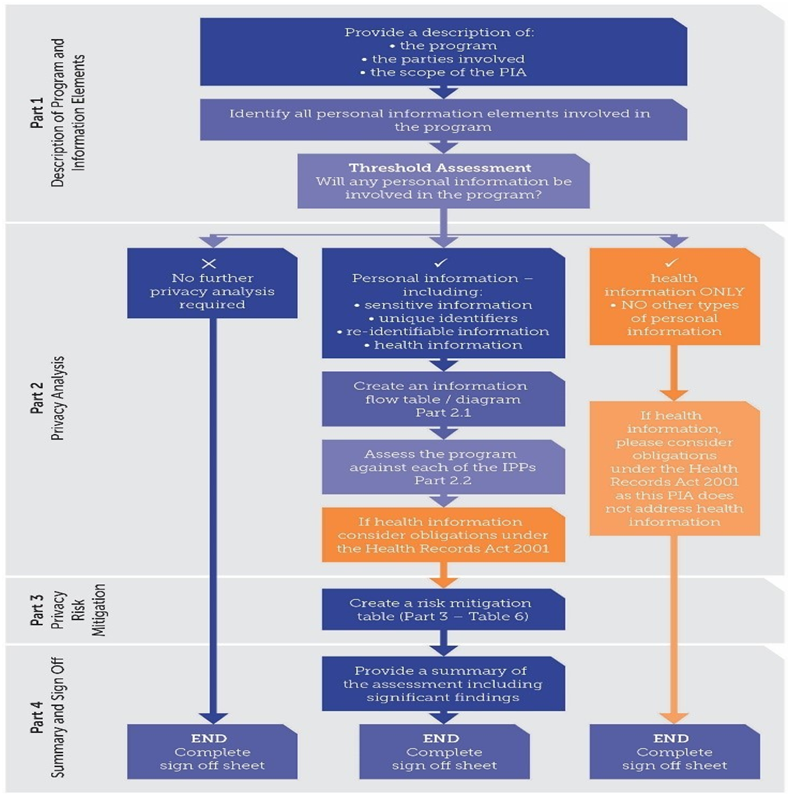
  1. Determine whether a PIA is necessary (threshold analysis)
  2. Identify the PIA team, its terms of reference, resources and time frame
  3. Prepare a PIA Plan − who does what, when and with whom will you consult
  4. Agree on the budget for the PIA
  5. Project description (link to corporate strategy, external environment and competitive landscape)
  6. Identify relevant stakeholders
  7. Analyse the information flows and privacy framework
  8. Privacy impact analysis
  9. Consult with stakeholders
  10. Check the project complies with relevant legislative requirements
  11. Identify risks and possible solutions
  12. Formulate recommendations
  13. Prepare and publish the PIA Report
  14. Implement the Recommendations
  15. Third−party review andƒor audit of the PIA & its implementation
  16. Update the PIA if there are any changes
  17. Incorporate identified risks into a centralised risk register
  18. Embed Privacy awareness throughout the organisation and ensure accountability

A PIA Flow− chart (Vict)

Supply Chain PIAs

  • Privacy risks emerge not only within a business itself, but also within its supply chain
  • Evidence that suppliers have undertaken effective PIAs may be required
  • Privacy officers might prioritise suppliers based upon their privacy risk profiles
  • High−risk: on−site visits and privacy audits may be necessary
  • Low−risk: sight the supplier’s privacy or infosec policies

In the EU, “High risk” business strategies have two of the following features:

  • evaluation or scoring, including profiling and predicting;
  • automated decision making with legal or similar effect;
  • systematic monitoring including of public accessible areas, in particular where there may be a lack of awareness of the monitoring;
  • processing of sensitive data, which in this context includes not only data defined as “special category” data under the GDPR, but data which may be generally considered as increasing possible risks individuals eg, financial data that may be used for payment fraud;
  • large scale processing, which should be considered by reference to factors such as the number of data subjects (whether the specific number or the proportion of a relevant population), the volume and range of the data, the duration or the permanence of the data and the geographical extent of the processing;
  • data set matching or combinations;
  • processing of information in relation to vulnerable data subjects where there is an imbalance of power between the controller and the individual eg, children, employees or vulnerable segments of the population such as asylum seekers;
  • innovative use of technological organisational solutions such as biometrics or the internet of things;
  • cross border transfers taking into account the country of destination, the possibility of further transfers and the likelihood of transfers based on derogations rather than exemptions; and
  • prevention of exercise of rights or the use of a service or contract eg, credit reference screening (which would also come under the evaluation or scoring category) resulting in an individual being denied a loan

PIA Reports

Sets out:

  • The scope of the PIA undertaken and its methodology;
  • A summary of the consultative processes undertaken
  • a description of the project
  • A map of the information flows
  • Analysis of the privacy issues and risks arising from the PIA, (including compliance, ethical, social licence and best−practice perspectives)
  • Recommendations to manage identified privacy issues and risks
  • The business case justifying privacy intrusion and its implications, where treatment or mitigating access has not been recommended andƒor agreed (if any)
  • A description of agreed treatment or mitigating actions together with timelines for implementation
  • References to relevant laws, codes and guidelines
  • When the most recent privacy review was undertaken

Adding in the assessment of ethical considerations

  • PIAs should not just be about compliance with the law (i.e. getting away with as much as the law will permit you to do)
  • Ethical analysis is a process which considers what you should or should not do, rather than just doing whatever the law permits you to do
  • Is this the right thing to do for our stakeholders, rather than just for ourselvesƒ our shareholders?

Social Licence

  • A concept developed in the mining industry
  • Metaphorical, not legal
  • ‘to go beyond compliance to mitigate social and environmental harm, or even to effect benefits’
  • Think of the broader privacy ecosystem − situate the project within that ecosystem and show how it will make the ecosystem healthier
  • What actions will minimise community stakeholder resistance to the project? What are their ‘pain points’?
  • Should not be a “political licence to operate”

APP questions to consider

  • Not every APP will be relevant for every project, but all 13 of them should be analysed to determine if they are relevant
  • OAIC Guide to Undertaking PIAs (2014) sets out basic questions to ask − adapt and extend them to suit your needs
 
Looking for a Similar Assignment? Order now and Get 10% Discount! Use Coupon Code "Newclient"