ECON 545 WEEK 7 FINAL CASE STUDY OUTLINE

Week 7 Case Study Outline
Regional Macroeconomic Analysis
Final Case Study – Overview: 2 Pages is required
Next week, you will complete a 200-point Final Case Study. The current assignment is 60 points. After you finish this, I will ask the next part another assignment extending this outline for my portion. This week, you will complete a high-level outline assignment. This week’s outline and the corresponding peer review discussion this week will both be very useful to you as preparation.
Employment Indicators (wages) —Work on this Indicator.
Final Case Study Outline Assignment Description (60 points)
For this assignment, you need to briefly inform your professor about your plans for your final case study. Basically, what macroeconomic indicators do you intend to research for your region and how you are going to conduct the research.
Below are some helpful notes for completing the outline.

Section 1: Introduction 

Briefly state the name of the region (Phoenix city) that you are going to analyze. Also, state the major strengths that make your region unique.

Section 2: Data Collection and Analysis

Data: state the type of data and the time range of the data you are going to obtain. Also, state the sources (if you have them) where you are going to obtain your data from and share links to the sources if you have any.
Analysis: State what your plans for this section and how are you going to approach the findings from your data section.
NOTE: You do not need to provide the actual data, findings, analysis and/or a solution for the outline assignment.
Reference List
Use at least 2 professional sources to support your argument. The references must be in APA format.

 
Looking for a Similar Assignment? Order now and Get 10% Discount! Use Coupon Code "Newclient"

ECONOMIC ASSIGNMENT ANSWERS: EFFECTIVE WORKING CAPITAL MANAGEMENT INTEGRAL TO OPERATIONAL EFFICIENCY

Article
Press release

Effective Working Capital Management Integral to Operational Efficiency:EY

2 February 2014, Mumbai: A review of working capital performance among the leading companies in India during 2013 reveals a marginal improvement, as compared to 2012, with their cash-to-cash dropping by 2% according EY’s latest report on Working capital Management ‘All Tied Up India 2014’.
The report is based on the working capital performance of 500 leading companies in India. These working capital results were achieved in the context of a marked slowdown in the Indian economy during the year as well as challenging global economic and financial conditions.
Ankur Bhandari, Partner – Working Capital Advisory Services EY India says, “There is a natural tendency among many companies to blame tough business environment for poor performance as customers struggle to pay on time, supply chains fail to keep pace with falling demand, and suppliers seek to get early payments. Companies should pay more attention to working capital management as they seek to release cash to support operational cash flow demands, fund capex and improve bottom line.”
A review of the performance of the leading 500 companies in the country reveals that sales growth has halved, operating margins of the majority of the companies have declined, debt levels are continuing to rise and ROCE (Return on Capital Employed) is at a five-year low. Consequently, Indian companies have been scrutinizing their balance sheets and are actively seeking ways to enhance their cost efficiency, release cash and optimize the structures of their assets, the report states.
The report states that compared to their peers in the US, Europe, Japan and other Asian countries, Indian companies are at the bottom of global working capital performance. While this may be partly due to variations in their business models and geographic footprint, it also points to fundamental differences in the degree of management’s focus on cash and in the effectiveness of working capital management processes against the backdrop of rapidly changing business, financial market and regulatory conditions.
According to the report, not treating working capital as an operational issue, poor system data management, insufficient focus on continuously adapting business policies and processes to a rapidly changing environment appear to be the primary reason for the divergence in working capital trends between India and the US and Europe.
EY’s research also reveals a considerable disparity in the working capital performance of Indian companies within the same sector, which clearly indicates that there is potential for significant improvement. A high-level comparative analysis conducted by us reveals that Indian companies have up to INR5.3 trillion (US$97 billion) in cash unnecessarily tied up in their working capital processes. This is equivalent to 12% of their aggregate sales.
“Our experience shows that there still are a number of areas within management’s own influence that can be dramatically improved upon such as timely billing, credit blocks and proactive collection, establishing responsive supply chain to adjust inventory in real time with demand, and improved spend category management. This can lead to a substantial and sustainable cash release in a relatively short period of time. Otherwise, the high debt and related interest costs will continue to eat into the bottom line forcing working capital laggards to lose financial strength and eventually erode their ability to compete in the market”, adds Ankur.
The report also gives some suggestions on what companies in India should focus on in order to implement effective working capital management strategies to raise cash and improve operational efficiency. This will involve adopting a structured “root and branch” approach to improve their management of working capital. They will need to target all key operational levers and implement a robust supporting infrastructure, including focused metrics, aligned incentives and strong risk management policies. Other essential enablers include application of lean manufacturing and supply chain initiatives, effective management of payment terms with customers and suppliers, closer collaboration with each of their partners in the “extended enterprise,” globalization of procurement, and taking an approach that balances cash, cost and service levels.
-Ends-
(Source: http://www.ey.com/IN/en/Newsroom/News-releases/EY-Press-Release-effective-working-capital-management-integral-to-operational-efficiency)
Based on the article given, you are required to:
Question1
Analyze on the effectiveness of working capital management in a company’s operation and further discuss on the risk-return trade-off involved in managing a company’s working capital.  (50 marks)
Question 2
Discuss on the challenges encountered in managing a company’s working capital and provide your suggestions on how to improve the working capital management.  (50 marks)
(Total: 100 marks)
 
To attempt this assignment successfully, students need to explicitly use the article given as an academic reference. Students are required to use and analyze literatures in order to support both of the answers. Each question should be assessed critically and rationally. References from books, articles or academic journals are required and marks will be reducing if none of the conditions apply.

 
Looking for a Similar Assignment? Order now and Get 10% Discount! Use Coupon Code "Newclient"

BSBHRM506 MANAGE RECRUITMENT, SELECTION AND INDUCTION PROCESSES ASSESSMENT TASK

Assessment Task 1: Develop Recruitment, Selection And Induction Documents Project

About your assessments:
BSBHRM506 Manage recruitment, selection and induction processes, this unit requires that you complete 4 assessment tasks.
You must complete all tasks to achieve Competency for this unit.
Write in the due date as advised by your assessor.

Assessment Task About this task Due Date
Assessment Task 1: Develop recruitment, selection and induction documents You must develop a recruitment, selection and induction policy and procedure and supporting documents. You must also participate in a meeting to discuss documents developed.
Assessment Task 2: Recruitment and selection project There are two parts to this task:§  Part A – You must meet with the Principle Consultant (your assessor) to provide training, to develop a job advertisement, and to identify and report on recruitment
§  Part B – You must approve the selection of a job candidate and develop a letter of offer and a rejection letter.
Assessment Task 3: Induction project You must manage the induction process and implement improvements to the induction procedure.
Assessment Task 4: Written questions You must correctly answer all 19 questions to show that you understand the knowledge required of this unit.

Task summary:

  • You are required to develop recruitment, selection and induction policy and procedure, as well as a position description template, a standard letter template and an induction checklist. You are then required to discuss these documents at a meeting with the Principal Consultant (assessor) in order to trial the documents and make the required amendments.

What do I need in order to complete this assessment?

  • Access to textbooks and other learning materials
  • Access to a computer and the Internet
  • Meeting space
  • Sample FairWork Australia induction checklist

When do I do this task?

  • Class-based students will do this task in the classroom or as homework
  • Workplace-based students will do this task in their own time

what do I need to submit?

  • Correspondence with the assessor with the following draft documents included:
  • recruitment, selection and induction policy and procedure
  • position description template
  • standard letter template for unsuccessful candidates
  • induction checklist
  • Correspondence with the updated documents

How to submit your assessments?
When you have completed each assessment task you will need to submit it to your assessor.
Instructions about submission can be found at the beginning of each assessment task.
Make sure you photocopy your written activities before you submit them – your assessor will put the documents you submit into your student file. These will not be returned to you.
Assessment Task Cover Sheet
At the beginning of each assessment task, you will also receive an Assessment Cover Sheet. Please fill it in for each task, making sure you sign the student declaration.
Your assessor will give you feedback about how well you went in each task, and will write this on the Assessment Cover Sheet.
Assessment appeals
You can make an appeal about an assessment decision by putting it in writing and sending it to us. Refer to your Student Handbook for more information about our appeals process.
what do I need to do if I get something wrong?
If your assessor sees that you have not demonstrated the required skills/techniques and have not been marked as satisfactory; you will be provided with an opportunity to redo the parts of the task that are incorrect. The details of resubmission will be discussed directly with you.
Instructions to students:
Grow Management Consultants is a small management consultancy business specialising in leadership development services.
The company was established by Paul Burn, the Principal Consultant. A number of senior consultants are employed on a contract basis. The company also employs a Client Relations Manager and an Administration Officer. The company has recently employed a Human Resources Manager.
Grow Management Consultant’s Strategic and Operational Plan includes the following information:
Mission Statement:
Grow Management Consultants are committed to promoting individual and organisational leadership excellence. We do this by providing mentoring, training, coaching, consultation and program evaluation; offering cutting edge tools, resources and expert advice; sharing best and next practices; leading
organisations through the process of creating a leadership culture; and, recognising and celebrating excellence in leadership.

Strategic objectives for 2015 – 2016 are identified as followed:

  • Implement strategies to retain customers
  • Increase sales by 10%
  • Register as a training college in order to be able to offer accredited training to existing clients
  • Develop our human resources by implementing a formal human resources framework Operational priorities are as follows:
  • Design and develop a monthly newsletter to send out to all clients (Responsibility: Principal Consultant; Timeline: newsletter to be in operation by September 20XX)
  • Create a blog page on web site to provide regular latest news (Responsibility: Principal Consultant; Timeline: immediately)
  • Employ new full-time Accounts Manager (Responsibility: Principal Consultant/Human Resources Manager; Timeline: Accounts Manager employed by July 20XX)
  • Offer senior consultants the opportunity to become permanent employees (Responsibility: Human Resources Manager; Timeline: Permanent status finalised by end June 20XX, contracts revised)
  • Recruit two new senior consultants on a contract basis (Responsibility: Principal Consultant/Human Resources Manager; Timeline: New senior consultants appointed by August 20XX).
  • As part of the formalisation of the human resources function, you have been asked as a first step to develop an appropriate recruitment, selection and induction policy and procedure, as well as a sample position description template that can be used to document all new positions.
  • Note that the Principal Consultant has requested that interviewing of staff be completed by line managers rather than human resources, as he considers this is more effective as line managers have the technical expertise to select staff.

As the Principal Consultant is also interested in using social media for recruitment purposes, you have also been asked to research options for using social media for recruitment and to report back on this, including your recommendations for use of social media.

  1. Review the information above. In your role as Human Resources Manager, prepare a memo (or email) to the Principal Consultant confirming the strategic objectives and operational priorities of the organisation, including an outline of the new positions to be recruited, as well as confirming the actions you will take to achieve these objectives and priorities as per the scenario information.
  2. Develop a draft recruitment, selection and induction policy and procedure for Grow Management Consultants. Your policy statements should be short and concise and your procedures brief but clear and written in plain English in order to ensure usability by all.

Your policy and procedure should include the following:

  • Purpose of the policy1
  • Scope – who it applies to, as well as relevant commonwealth and state/territory legislation addressed by the policy and procedure2
  • Objectives of the policy and procedure, including equality and diversity3
  • Roles and responsibilities4
  • Procedures for:
  • identifying a vacancy5
  • developing a position description (using a template)6
  • information to be provided to candidates7
  • advertising, including information about where positions should be advertised and the information that should be included8
    • advertising on Seek should be the preferred advertising location.
  • method of application9
  • shortlisting procedure10
  • interview11
    • face-to-face interviews should be the preferred option
  • selection12
    • online psychometric testing and online personality profile testing should be included
  • appointments13
  • record keeping requirements14
  • induction15
    • a meeting with the HR Manager and the employee, and the manager separately, at the end of probation should be included.
  1. Develop a draft position description template. As a minimum, the position description template you develop should include the following headings:
  • Job title
  • Location
  • Reporting responsibilities (who is the manager/supervisor)
  • Main duties/responsibilities
  • Skills and experience
  • Performance goals.

The position description template should provide brief notes under each heading to guide managers in completing the template.

  1. Develop a draft standard letter template for unsuccessful candidates (that have been interviewed for a position). The template should be presented in a professional business letter format with space available for the position and candidate information. The letter should be written in clear and concise English and be free of errors.
  2. Research and develop a draft induction checklist that could be used by Grow Management Consultants for any new staff member. The induction checklist should be approximately one to two pages and include brief instructions to managers about completing the checklist.
  3. Send the memo and draft documents you have developed to the Principal Consultant (this will be your assessor) by the required date, and request a meeting to discuss the policy and procedures, sample position description template, letter template and the induction checklist.

Your assessor will provide you with a date, time and location for the meeting.

  1. Participate in a meeting to discuss all of the documents you have developed. Your assessor in the role of Principal Consultant will ask you questions and provide feedback.

During the meeting you will need to demonstrate effective communication skills including:

  • answering questions about the documents developed
  • communicating information, speak clearly and concisely.
  • providing clear answers to questions
  • using active listening techniques to confirm and clarify information and suggestions.
  1. After the meeting, update your documents according to the feedback provided to you by the Principal Consultant (your assessor).
  2. Submit the final revised version of each document to your assessor within three days of the meeting.

Assessment Task 2: Recruitment and Selection Project

Part A – Manage recruitment

Instructions to students:

The Principal Consultant has approached you to discuss the appointment of a number of new staff. He has indicated that he is not sure whether to recruit the Accounts Manager or the senior consultants.  He has requested a meeting with you to help determine which position to recruit first and to run through the policy and procedure for recruitment and selection and how complete the position description template.

Complete the following activities:

  1. Meet with the Principal Consultant (your assessor) to provide training in regard to the policy and procedure for recruitment and selection of candidates and completing the position description template you developed in Assessment Task 1.

During this meeting you will also discuss and determine which position the company will recruit first. You are required to participate in the discussion, ask questions and provide advice that correlates to the policy and procedure.
Provide a printed copy of the policy and procedure and the position description template for the meeting and go through each of the areas in the template that need to be completed, as well as the level of detail that is expected.
You will be required to demonstrate effective communication skills by speaking clearly and concisely, responding to questions and active listening.

Following the meeting the Principal Consultant (your assessor) will provide you with the completed position description for the role of the Accounts Manager as well as information on the proposed remuneration for the position. The Principal Consultant has told you that he wishes to explore the use of social media in recruitment further (eg there are costs for using LinkedIn for recruitment) but for the time being he would like you to write an advertisement to be placed on Seek.

  1. Develop a job advertisement in accordance with the organisational and legislative requirements as specified in the recruitment, selection and induction policy and procedure that you developed as part of Assessment Task 1. Your advertisement must clearly reflect the requirements of the position description, as well as include brief company information and remuneration details.Your assessor will review both your advertisement, as well as the recruitment, selection and induction policy and procedure you developed to assess this.
  1. Research at least two recruitment consultants that could be used, should the Seek advertisement not attract the right kind of candidate. Identify the services offered by the recruitment consultants, as well as contact details and any other useful information.
  2. When you have completed the advertisement, send it to the Principal Consultant for approval prior to advertising. Your covering memo or email should include information on the research that you have conducted in regard to the recruitment consultants and why it may be necessary to use these consultants.

Part B – Manage selection process

Instructions to students:

Applications have now closed for the position of Accounts Manager and the selection panel has completed the assessment and chosen the short list of preferred candidates. Your role includes calling each candidate to arrange their face-to-face interview and to explain the selection process, which you have done.
Part of the selection procedure for all roles is to complete an online psychometric test and an online personality profile test. The Principle Consultant has asked if you can skip this part of the process for one of the candidates because they have been recommended by a business associate.

  1. Prepare and send a memo or an email to the Principal Consultant with an overview of the selection procedures as per the recruitment, selection and induction policy you have developed. You should also use this opportunity to gently explain why it is important to apply the same procedure to all candidates.
  2. The next part of the procedure is to confirm the face-to-face interviews by email.

The proposed interview date is 6 October and interview times being 10 am, 11 am, 2 pm and 3 pm. Each interview is expected to take 1 hour and candidates will be asked set questions which they must reply to. The location of the interview will be at Head Office – Level 1, 10 Martin Street, Newcastle. There will be two interviewers, you as the Human Resources Manager and the Principal Consultant.
Develop a suitable email with the required position and interview information and including your information in the email signature. The first interview at 10am is with Maggie Perez so address the email to Maggi and send it (to your assessor).

  1. Assume that the interviews have been conducted. You need to review the selection report produced by the selection panel (provided by your assessor) and decide to endorse/not endorse the panel’s selection decision of the preferred candidate for the role of the Accounts Manager. Complete the highlighted sections of the selection report to show your decision and return the completed report to the Principal Consultant (your assessor).
  2. Develop a letter of offer for the candidate that will be appointed.

The name of the candidate is Maggie Perez and her address is 2/5 Belmont Gardens, Belmont NSW 2573.
Use the letter of offer template provided by your assessor and populates it with the information from the position description.
You may date the letter of offer as the date on which you submit the letter.

  1. Prepare the letters to the unsuccessful interview candidates using the letter template that you developed in Assessment Task 1. The candidate information can be found in the selection report.
  2. Submit the letter of offer and the letters informing candidates that they were not successful to your assessor by the date specified by your assessor.

Assessment Task 3: Induction Project

Instructions:

It is now another two weeks later and Maggie, the new Accounts Manager will be commencing her employment the following week.

Complete the following activities:

  1. Send the induction checklist that you created in Assessment Task 1 to the Principal Consultant (your assessor). As the Principal Consultant is just about to provide Maggie’s induction, include an overview of the induction process in a memo or an email as per the recruitment, selection and induction policy and procedure. Ensure you include timeframes in your overview.
  2. Review the following information:

It is the end of Maggie’s probation period and you meet with the Principal Consultant to discuss Maggie’s performance.  The Principal Consultant indicates that while he is happy with Maggie’s performance overall, she doesn’t seem to be as productive and motivated as he would like.  He explains that she sometimes seems to be waiting for direction instead of getting on with things.

  1. Meet with Maggie (this will be your assessor). Your assessor will advise you of the date and time of the meeting. At the meeting you will need to explain the feedback from the Principal Consultant and enquire as to Maggie’s views on this.

During the meeting you will need to demonstrate effective communication skills, including speaking clearly and concisely, responding to questions and active listening. You will need to demonstrate appropriate non-verbal communication skills to show that you are open to Maggie’s views, as well as being empathetic. Maggie tells you that she is disappointed that it has taken three months, the end of her probation to be told her performance isn’t up to scratch.

  1. Assume that based on the outcome of the meeting above, one of the improvements you decide to make is to the induction process in terms of building in more formal feedback sessions via meetings instead of leaving all of the feedback to the end of probation. You have heard that other organisations are doing this so you decide to research strategies.
  2. Following your review, develop a memo or an email to be sent to the Principal Consultant (your assessor) that outlines recommendations for improving the induction process as documented in the organisation’s recruitment, selection and induction policy and procedure.
  3. Amend the induction process in the recruitment, selection and induction policy and procedure based on feedback provided by your assessor in return correspondence.
  4. Update the policy and procedure and submit it to your assessor.
 
Looking for a Similar Assignment? Order now and Get 10% Discount! Use Coupon Code "Newclient"

INTERNATIONAL BUSINESS (IB) -ASSIGNMENT ROADMAP AND CASE STUDY ANALYSIS ANSWERS

Assignment Roadmap

No. of Words: 5000
Module: International Business (IB)
Topic: Investigating Nedbank’s internationalisation into Egypt
 
Executive Summary (~ 500 words)
Write this up last – once you have completed your full assignment.
Provide a concise summary of:

  • Introduction (business intro, context)
  • Key issue (why the business is considering internationalisation)
  • Brief discussion of analytical approach taken (what did you analyse and how)
  • Key insights from the four levels of analysis (i.e. macro, market, competitors, internal)
  • Options derived in terms of internationalisation (“where” and “how”)
  • Summary of final decision/recommendation, including both the “where” and “how”
  • Summary of the key implications and next steps

Typically, each bullet point above will translate into a paragraph in your executive summary, bar the analysis point, which may require more.
Extra – Have a read through this article, which discusses the executive summary in more depth:
https://grad.coach/how-to-write-an-executive-summary/
 
Chapter 1: Introduction (750 – 900 words)
You will need to cover the following:

  • Provide a brief introduction to Nedbank’s operations – what does it do (in layman’s terms), where does it operate, how long has it been in business, who is its customers, what are its business objectives and basic strategy (i.e. its plan to achieve its objectives).
  • Explain any relevant terminology and/or jargon regarding the product offering.
  • Explain the context, which leads to the opportunity and justifies the focus of the assignment: o what context has led Nedbank to want to consider internationalisation (or further internationalisation)?
  • There are various push and pull factors that might drive a firm to consider going abroad – for example, an increasingly competitive local landscape, local economic uncertainty or decline, etc. Consider some of the “push and pull” factors as per the IB theory and make a clear argument as to why Nedbank would entertain going abroad as opposed to just focusing their efforts on gaining more market share at home (SA). I have included the relevant “push and pull factors” model on the next page for your easy reference.

Which market/s (country/ies) is it interested in and why?
Explain why Country X, in particular, is on the shortlist (or if you choose to analyse two markets, why they are both on the shortlist).
You don’t need to go into much detail here, but there’s needs to be some brief explanation as to why you’d consider venturing into this country.

  • Simply put, this section is about providing a justification for the investigation. Make it clear why this topic is important to the business (i.e. what is its logic for internationalisation?) and why you’re assessing Country X specifically.
  • Present the research questions (RQs), namely: o RQ1: Should Nedbank consider internationalisation into Country X (and/or another country)?

RQ2: If so, which entry mode would be most appropriate?

  • Outline your theoretical approach to the analysis – a brief overview of what models and frameworks you used, in what order (we’ll cover this in the next section). Do this right at the end of the writing process.
  • Briefly discuss your approach to the fieldwork – what information sources did you use? For example, informal interviews, industry reports, company-provided data, etc.
  • Mention your relationship to the organisation (if you haven’t already) and how you’re involved in this specific challenge, if at all.

Below: the push and pull factors for internationalisation (for discussion in your context section)
The Internationazing firm
Extra – You might find the following post useful for guidance on how to write a strong introduction chapter:
https://grad.coach/introduction-essentials/
 
Chapter 2: Analysis (2000 – 2400 words):
The analysis chapter can be approached using Collinson et al’s (2017) “international business environment” model (see below) as a guiding structure, flowing from right to left.
Internal firm environment
In other words, your analysis should cover four main areas:

  1. Macro-level / institution-based analysis (CSAs) – is Country X itself attractive in terms of the institutional environment it offers to businesses? E.g. laws, ease of business, etc.
  2. Meso-level (industry):

(a)   Market analysis – is there an attractive local market in Country X that will be interested in your offering (market size and receptiveness)?
(b)   Competitor analysis – how competitive is the local playing field and is there a gap that you can fill (an opportunity to differentiate yourself)?

  1. Internal-level analysis (FSAs) – do you have the resources and capabilities to overcome the liability of foreignness (LoF) that you will face? Can you provide a differentiated offering?

In terms of order, it’s always best to have your analysis flow from macro to meso to micro (internal), so I suggest ordering your analysis as presented above.
 
2.1 – Macro-level / institution-based analysis (CSAs)
This section will look at the “big picture” of Country X to assess the general attractiveness of doing business there and how big a leap this is from doing business in your home country (i.e. your liability of foreignness). In other words, the key questions here are:

  1. How attractive is the institutional environment?
  2. What are the key risks, challenges and contributors to liability of foreignness (LoF)?

Internal firm environment 2
Keep in mind that the focus at this stage is on Country X as a country itself, not the customer market or competitive environment within that country (these will come in the next section). However, you should still be making links between these levels, as the macro typically impacts the meso. Moreover, given that your internal analysis only takes place later, your macro-level analysis should be taking a generic perspective, not a firm-specific perspective. In other words, how appealing if the institutional environment for any new entrant or competitor in your industry?
The PESTLE framework works well here to investigate the macro aspects of the host country. Don’t bother trying to fit it in a table – rather discuss in body copy. It is also prudent to integrate/blend PESTLE with Ghemawat’s CAGE framework to enrich the analysis and draw comparisons between home and host country. There is a lot of overlap between these two models, so they integrate well together – see table below which highlights the overlaps.
PESTLE and Cage framework
have sourced a few macro-level country reports for Egypt and Algeria. Quality reports for Sudan were impossible to come by, so I’d suggest focusing on Egypt and/or Algeria, unless you have macro-level data for Sudan.
You can also do some Googles searches for “Country X PESTLE”, “Country X country report”, etc. Make sure you search for recent reports (late 2019/ early 2020), as this information needs to be fresh. I can assist if you have trouble finding these reports (the ARC is not very user-friendly) – let me know.
For economic data, you can use World Bank, World Economic Forum and CIA Factbook data (all easy to find on Google) to source this info. All of this is freely available online – just search on Google. See, for example:

  • https://tradingeconomics.com/egypt/indicators
  • https://data.worldbank.org/country/egypt-arab-rep

You can also use the CAGE comparator (https://ghemawat.com/cage) to get a CAGE comparison between the countries.
I’ve included some thought-starters for your PESTLE/CAGE analysis below. You don’t need to cover every point – just focus on that which is most relevant to the overall research questions.
 
Political & legal:

  • Extent and efficiency of government bureaucracy – how easy is it to set up a business in the country? See http://www.doingbusiness.org/rankings
  • Taxation laws – how attractive is the tax system? Are there any incentives for foreign investors in your industry? Consider both corporate and income tax, as the latter impacts the cost of labour.
  • Foreign ownership laws – are foreign persons or entities allowed to own companies? What restrictions exist? Are there any exemptions?
  • Profit repatriation – are companies allowed to repatriate profits to their home countries? What limits and complexities exist.
  • Regulation – how regulated is the industry at hand? Is this regulation attractive or are you ill-equipped to work with it?
  • Labour laws – how attractive are the labour laws for employers? Do they allow for easy import of foreign talent (this will likely be important when starting up)?
  • Law and enforcement – Is the legal system based on common law? How effective is it? Is intellectual property protected?
  • Corruption – see data at https://www.transparency.org/country

 
Economic:

  • Look at some basic top-level country economic information for Country X over a 3-5-year period, including population, GDP, GDP growth, FDI, GDP per capita, etc. What does this tell you about the general state of business?
  • Consider economic integrations/unions and the impact that this has on country attractiveness.
  • Then, give some thought to the economic factors that impact your running a business in Country X, for example: o Availability and cost of corporate credit – how easy is it to raise debt financing? Same for equity?
    • Currency stability – how stable is the local currency, are companies allowed to trade in a more stable base, or can they hedge to reduce their exposure to volatility? How about exchange control restrictions?
    • Comparative wage rates – how affordable is quality labour? Try find industry-specific data on PayScale, GlassDoor, etc and compare to costs in the home country.
    • Comparative office space rates – how affordable is work space?

 
Socio-demographic:

  • Consider how socio-demographic metrics impact the local workforce, which you will likely need to employ. I.e. will you be able to find the skills you need, at the right price? o Education levels and industry-specific skills
    • Native languages and prevalence of English
    • Work ethic; quality of work life
    • Crime, theft and security
    • Culture – this one impacts both staffing and customers. What are the key differences and how substantial are they? You can use Hofstede’s data for this – see https://www.hofstede-insights.com/product/compare-countries/

 
Technological:

  • Are there any technology compatibility considerations that may create challenges (or opportunities)?
  • Does the host country have the technology needed/support infrastructure for your industry?

 
Environmental:

  • Environmental issues that may count against you or aid you (e.g. “green” legislation or incentives, public stance/expectations re environmental issues, etc).
  • Practical differences that impact the ease of doing business: o Differences in time zones
    • Physical distance and travel time from the home country
    • Quality and accessibility of airports
    • Terrorism threats

Important – When writing up this section, it is very easy to slip into the trap of descriptive writing, as opposed to analytical writing. In other words, you present a whole lot of data, facts and figures, but fail to discuss what the impact of these points are. Your analysis doesn’t connect back to the research questions. To avoid this, make sure that for each section of writing, you make it clear whether the data, facts or figures:

  • Increase or decrease the institutional attractiveness
  • Present a potential liability of foreignness
  • Impact potential entry mode options (for example, if 100% foreign ownership is not allowed)

If you consistently link the discussion back to these three considerations, you’ll have a rich analysis. For more information on analytical writing, see https://grad.coach/analyse-dont-describe/.

Round off the macro-level analysis with a brief concluding summary. Importantly, this summary should make it clear:

  • How attractive is the country from an institutional perspective?
  • What are the key differences between your home market/country and Country X? In other words, what are the contributors to your “liability of foreignness”.

 
2.2 Customer/market analysis (demand-side analysis)
Now that you’ve assessed the institutional environment in terms of its attractiveness, it’s time to assess the industry-level environment (highlighted below).
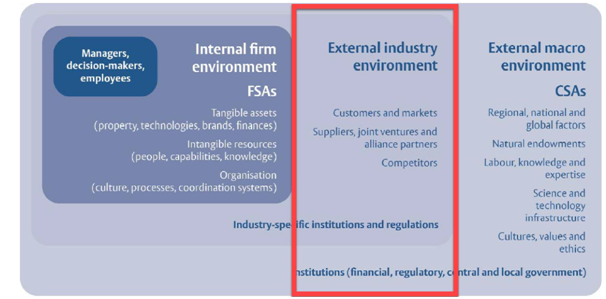
Internal firm environment 3

The starting point is the demand-side/market side – i.e. what is the potential market for your specific offering? There are many aspects to consider, but the key questions to address are:

  • How large and profitable (i.e. attractive) is the potential local market for your offering? How does this compare to the home country or other markets you’re involved in?
  • How receptive are they likely to be to your offering? Do they need it (and know that they need it?) This will depend, in part, on the level of competitiveness (which you’ll assess in the next section).
  • What are the potential barriers (liabilities of foreignness) you’ll face in terms of selling to this market?

There’s no specific model, framework or theory to apply in this section. You just need to present the information in a logical, digestible fashion. Supporting data in the form of charts/graphs demonstrating market trends can add a lot of value in this section.

  • It would be good to present some information about:
  • The size and growth rate of the market
  • The lifecycle of the market (e.g. embryonic, growth, mature) and what that means in terms of future attractiveness (will it grow or decline?)
  • Any PESTLE/CAGE-type factors that impact potential customer demand (for example, cultural differences that will impact how you sell, market, etc).
  • Also consider the regional market access that being based in Country X might provide (i.e. neighbouring countries), given FTAs/unions/integrations in the region (which you would have touched on in the macro analysis).

As always, consider both the pros and cons – what aspects are attractive and what aspects will contribute towards your LoF? Oftentimes, cultural differences present a substantial LoF – don’t try downplay this. The more critical (balanced) the analysis, the better.


Looking for a Similar Assignment? Order now and Get 10% Discount! Use Coupon Code "Newclient"